top of page

3rd MAY 2027

PARENT’S / GUARDIAN’S / ATHLETE’S GUIDE FOR TRISTARS

See separate tab for Triathlon Guide for adults (15yrs+) races

PARENTS / GUARDIANS / COMPETITORS MUST READ THE FOLLOWING IMPORTANT INSTRUCTIONS.

IT IS IMPORTANT THAT CHILDREN ARE ACCOMPANIED AT ALL TIMES BY THEIR PARENTS / GUARDIANS EXCEPT AFTER THE ATHLETES ENTER THE POOL AND UNTIL COLLECTED AFTER THEIR RUN FINISH – as detailed below in red.


Entry process & swim time:

This is all online via the StuWeb portal via the various "Enter Here" links on this site. It is important please you register an accurate estimate of your swim time so the swim can run smoothly.

"Club" name (on entry):

Equally important is that you enter under your "club" name if you want your results to be included in the South East Junior Race Series (if / when we know our Aquathlon is approved). If you are not a member of a club perhaps enter under a sports team, school name or other club, as we are considering team prizes of some sort. So watch this space!


Venue:   

Tonbridge School, Tonbridge, Kent. TN10 3AD


Car parking:

Please note that due to the popularity of the event, there is no competitor parking on site. Please follow the directions given by the marshals and follow the signs to the designated town centre car parks.  These car parks are located at The Castle, The Ivy House pub, Town Swimming Pool, plus more car parks in the centre of town (perhaps a 10-minute walk from the venue).

​The Registration point is signposted in Tonbridge School Sports Centre.

Drop off points (2 minutes wait time) are available in Dry Hill Park Road at Hilden Grange School (north bound) and Cowdray House (south bound) if athletes are seeking a shorter walk to the venue.


British Triathlon Competition Rules:

Please take time to familiarise yourself with the rules under which this triathlon operates: https://www.britishtriathlon.org/competitionrules


Race passes:

All competitors MUST have a race pass either bought via the Stuweb online entry process, or by virtue of any athletes already being “competitive” members of British Triathlon (membership numbers will be requested in the entry process). This provides required insurances.

No Race Pass = No Racing!

They were only £2 (2026).


Parental / Guardian consents:

By virtue of a parent / guardian entering a Tristar athlete to race consent is deemed given for them to race, taking on board the information given and risks involved, and for the taking of photographs and/or recordings.

If you are not happy with this do not enter until discussed / resolution agreed.


Timings:

Start times will be confirmed a few days before the racing.

Provisionally, subject to entry numbers, we expect the older children (Tristar 3) to start first, after all adults are finished in the pool, at about 11.15am (this may vary). The youngest / last athletes to start (Tristart) may be about an hour later.


​Registration:

Race day Registration will take place in the Sports Centre, Tonbridge School and we ask athletes (with parents /guardians) to register 45-60 minutes before their advised start time.

Race Passes will be checked.

At Registration, you will collect Race Numbers and safety pins and race numbers will be applied with marker pens to arms.

We ask that race numbers are affixed / used as follows:

  • 1st large race number to be pinned to the front of athlete’s running vest (front facing).

  • 2nd large race number to be kept by parent / guardian as “proof” of being attached to that athlete (to facilitate eventual bag and athlete collection – see below).

  • 1 small number to be stuck to the athlete’s “Transition bag”. There will be spare small number stickers.


Changing rooms / toilets:

It is ideal if athletes arrive “race ready” but changing rooms will be allocated to athletes (see signs in sports centre lobby).

Toilets will be signposted.

Tonbridge Lions Club / Tonbridge School does not accept responsibility for any property lost or stolen, so please look after your own property.


Numbered Transition bags:

All surplus clothing and “stuff” (ie not needed for the swim or run) must be locked away or looked after by parents / guardians. Numbered Transition bags are only to contain kit needed for the actual Swim, Transition and Run, including a small pat down towel if wished.


Timing Chip Issue:

No later than 15 minutes before start time, athletes (with parents / guardians) report to the lobby area outside the pool at pool level “swim ready” (run tops can be worn if wished at this stage) and with numbered Transition bag (run shoes to be placed in Transition bag at this point).

Timing Chips will be issued here – please check its number corresponds to the athlete’s race number prior to fitting it securely to the left ankle (check it is fitted well). For the duration of the event, the Timing Chip is your responsibility. There may be a charge levied if you fail to return your chip at the end of the event.


We suggest parents/ guardians assist in making their athletes aware of the next sections of the briefing as they are bid “good luck” and enter the pool for their Briefing alone.


Parents / guardians MUST keep the 2nd large race number (issued at Registration) on them as proof of which athlete they are attached to (for subsequent collection of athletes and bags).

Marshals will be at hand at all times to help / look after the athletes until parents / guardians collect them after their run finish.


Transition bags:

Once briefed Tristar athletes will get swim ready (ie run tops off … goggles in hand, swim hat [if worn] on) and check they have all their running kit and a small pat down towel perhaps placed in their numbered Transition bags. If the weather is inclement, they will be invited, if they wish, to temporarily leave their bags on poolside (where directed). Ideally (and definitely in good weather), they will head outdoors into the Transition area immediately outside the pool and leave their Transition bag in areas designated by numbers.

They then present themselves to the end of the pool nearest the lane they will start swimming in


Swim:

Swimmers will be started by a Starter one at a time, at about 15s intervals.

All swimmers will swim in a “snake” fashion as follows (also see schematic at bottom):

  • Swim anti-clockwise in the lanes.

  • At shallow end duck under the lane rope to the next lane for the next 2 lengths (N/A to Trisart who only swim 2 lengths).

Tristar 3: start in lane 6 – and swim a total of 12 lengths

Tristar 2: start in lane 4 – and swim a total of 8 lengths

Tristar 1: start in lane 3 – and swim a total of 6 lengths

Tristart: swim in lane 1 – and swim a total of 2 lengths

On completion they then head to where they left their Transition bags, exiting the poolside in due course via the poolside door near lane 1 into the outdoors Transition area.


Transition:

Athletes are not able to change their swim costumes, so are expected to run damp! Best they can do is pat themselves a bit drier very quickly as wished, don their running kit (ie socks, shoes, shorts and numbered top) and place swim hat, goggles and towel in their bag.

Such transition ideally takes place outdoors in the Transition area … but if the weather is inclement they will be invited to change on poolside.

In any event the Transition bags MUST be left in designated / numbered areas, as will be directed and signed, in the outdoor Transition area prior to running out onto the running track.


Run:

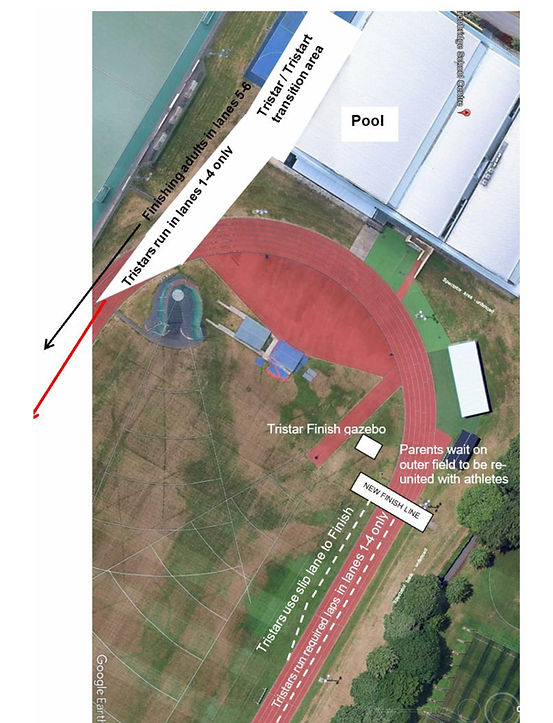
All Tristar / Tristart athletes follow the run signs out of Transition onto lanes 1-4 of the running track (the outer lanes 5-6 are for finishing adults).

Tristar 3: run 5.5 laps of the track to the finish line

Tristar 2: run 3.5 laps of the track to the finish line

Tristar 1: run 2.5 laps of the track to the finish line

Tristart: run 1.5 laps of the track to the finish line

IMPORTANT: Athletes need to know how many laps they are running and count laps run themselves.


​Finish and collection by parents / guardians:

​A few metres from the finish, on their last lap only, finishing athletes will veer off the running track to the clearly signed finish post.

Athletes then remain in the inner field area (out of bounds to parents / guardians / public) to: receive their medals and have timing chips retrieved by the marshals.

Marshals will then escort finished athletes across the running track (still in use) to their parent(s) / guardian(s) in the outer field area on presentation of a matching race number.

Medals & trophies (individual):

  • Medals: All athletes will receive a medal on completion.

  • Trophies: will be awarded asap, after race completion, to top boy and top girl in each of the 4 Tristar /Tristart events.


Medical notes:

The responsibility for ensuring that athletes are physically and medically fit to participate in this event lies with the parent(s) / guardian(s). It is crucial that you take a careful, honest assessment of your athlete’s health before committing to the race. You should ensure that they are in appropriate physical condition to compete, particularly if they have any underlying health conditions, a history of medical problems, or if they are currently experiencing any symptoms that might impair their performance or well-being.

If they have any medical conditions that could affect their participation, including, but not limited to, heart conditions, asthma, epilepsy, diabetes, or allergies, it is essential that this information is communicated to the event organisers and the on-site medical team. If you have any doubts about their ability to participate due to their health, or if you are unsure whether it is safe for them to take part, you should seek professional advice from your GP or healthcare provider before the event. Athlete’s health and safety must always come first.

In addition, if they are currently taking any medication, whether it is for a chronic condition or for an occasional issue, you should inform the event organisers and the medical team in advance. This allows the medical team to be prepared should they need assistance during the event.

Rest assured that all medical information you provide will be kept strictly confidential. It will only be shared with the event’s medical team, and only for the purpose of providing the safest possible care should an emergency arise.


Medical information:

A qualified medical team, with expertise in both trauma and medical emergencies, will be stationed on site. The team is equipped to handle a wide range of medical conditions, including serious medical emergencies, injuries, and conditions that might arise during the event. The medical team will be available before, during, and after the race, ensuring that athletes are supported at every stage of the event.

The medical team will have access to the necessary equipment, including defibrillators, oxygen, stretchers, and other advanced medical tools to manage emergencies and provide care on the spot. In addition to the medical team, there will be designated first-aid stations. These stations will be clearly marked, and staff will be available to offer immediate assistance if required.

It is essential that you complete the medical information section on the back of the athlete’s race bib prior to the event. This allows the medical team to have the necessary details in case of an emergency. The information should include:

  • Any pre-existing medical conditions.

  • Details of any medication being taking.

  • Known allergies.

  • Any other relevant health information that may affect race performance or health during the event.

This information will enable the medical team to deliver the most effective care should assistance be needed.


Is my athlete fit to compete?

There is absolutely no pressure to compete in this event. If at any point during the lead-up to the race or during the event itself the athlete feels unwell, fatigued, or unable to continue, we strongly encourage them to stop and seek medical advice. Athletes’ health and safety is the first priority. If athletes are experiencing symptoms of illness such as fever, muscle aches, shortness of breath, chest pain, or dizziness, we recommend that they do not race. In particular, if they are suffering from gastrointestinal symptoms (e.g. diarrhoea, vomiting), it is crucial that they avoid participating to reduce the risk of transmission to others and to protect their own health.

Please also consider that participating in a race while they are unwell, particularly if they have a viral infection, can compromise their immune system and prolong recovery time. Additionally, viral illnesses can be passed on to others, especially in crowded environments like those at race events. Therefore, if athletes have any symptoms of viral illness, including cold and flu symptoms, we advise against racing.

In addition to physical illness, stress, fatigue, or inadequate rest in the days leading up to the event can also hinder their performance or pose a risk during the race. If athletes are feeling exhausted, run down, or have not properly trained, it may be best to reconsider participating.

Ultimately, remember that the race is only one part of their fitness journey. Prioritise their long-term health and well-being over the short-term goal of finishing the race.


What if my athlete normally takes medication?

Many participants take medication for various health conditions, and in most cases, this will not disqualify them from competing. However, it is essential that you inform both the race organisers and the medical team about any medications they are currently taking. This is particularly important if the medication could affect their physical performance or if they may require access to the medication during the event.

Important considerations include:

  • Asthma inhalers: If they are asthmatic and use an inhaler or any other form of asthma medication, make sure they have it with them during the race (eg in Transition bag or with parent). Inform the medical team about this medication and the dosage in case assistance is needed.

  • Diabetes: If they have diabetes, please inform the organisers and ensure their diabetes medication (insulin, oral medication, etc.) and monitoring equipment (e.g. glucose meter) is at hand. Low blood sugar (hypoglycaemia) is a particular concern in endurance events, so ensure that you have the necessary supplies to manage their condition.

  • Blood pressure and heart conditions: If they are taking medication for high blood pressure, heart conditions, or any other cardiovascular-related issues, please make the medical team aware of this in advance. In some cases, the stress of a race can cause adverse effects, and it is important to have this documented to ensure swift and appropriate medical care if needed.

  • Antihistamines and allergy medications: If they are taking antihistamines or any other allergy medications, it is essential that the medical team knows this. Some medications can cause drowsiness or affect reaction times, which could increase their risk during the event.

All medications should be clearly labelled, and we recommend you carry them in a secure and easily accessible manner, such as in the Transition bag or with parent / guardian.

If you are uncertain about whether your athlete should participate or how their medication may impact their ability to race, please consult with your healthcare provider or GP well in advance of the event. Remember that keeping the medical team informed of your medication needs will allow them to provide the best possible care if an emergency arises.


Avoid dehydration:

Hydration is critical for performance and safety during the event. Dehydration can lead to severe complications such as heatstroke, kidney failure, dizziness, confusion, muscle cramping, and in extreme cases, death. Proper hydration is essential, both during the race and in the days leading up to it.

Here are some guidelines for staying hydrated:

  • Water intake: Drink small, regular sips of water throughout the race. Dehydration can sneak up, so it's better to hydrate before your athlete feels thirsty. However, do not overhydrate, as excessive water consumption can lead to a rare but serious condition called hyponatremia (low sodium levels in the blood), which can also be dangerous.

  • Electrolyte drinks: Consider drinking electrolyte solutions or sports drinks, especially if the event is long or held in warm conditions. These drinks help replace sodium, potassium, and other electrolytes that are lost through sweat. Electrolytes are essential for muscle function and can help prevent muscle cramps and fatigue.

  • Post-race hydration: After the event, it is crucial to rehydrate. Make sure your athlete drinks water and electrolyte solutions to replace the fluids and minerals lost during the race. This will help with muscle recovery and prevent post-race cramping.

Signs of dehydration to watch out for include:

  • Dry mouth or sticky feeling in the mouth

  • Dark yellow urine or infrequent urination

  • Fatigue, dizziness, or light-headedness

  • Cramping, particularly in the legs or stomach

After the race, make sure to hydrate progressively over the following hours, and consume a balanced meal that includes both protein and carbohydrates to support your recovery.

In summary:

  • Athletes’ safety and well-being are the priority. Do not race if they feel unwell or are unsure about their health.

  • Be sure to inform the medical team of any medical conditions, medications, or allergies.

  • Drink regularly throughout the race, maintain electrolyte balance, and ensure adequate hydration before, during, and after the event.

  • The medical team is available to assist athletes at any time during the event. Do not hesitate to seek help if needed.

Good luck, stay safe, and remember to prioritise your health above all else!


Site plans /schematics

schematic of Tristar areas.jpg
bottom of page